
Black rhinos in Nairobi National Park are identified most reliably by their hooked upper lip, browsing behaviour, higher head posture, smaller and more compact body, and their tendency to use thickets, shrubs and broken cover rather than spending most of their time grazing in open grassland. Nairobi National Park has both black and white rhinos, so visitors should learn the field differences before assuming that every rhino sighting is a black rhino. KWS describes Nairobi National Park as a rhino sanctuary with both black and white rhino present, which makes field recognition especially important during game drives.
For KifaruArk.org, black rhino identification should not be treated as a simple “black vs white” checklist. It is part of understanding why Nairobi National Park is a serious rhino sanctuary. A trained guide is not only looking at the animal’s colour or horn. They are reading lip shape, posture, habitat, feeding signs, tracks, dung middens, body size, ear position, horn wear, calf behaviour and the animal’s level of comfort around vehicles.
The quickest way to identify a black rhino
The most reliable single feature is the hooked, prehensile upper lip. Black rhinos are browsers. They use the pointed, flexible upper lip to grip leaves, twigs and shoots from shrubs and small trees. White rhinos have a broad, square mouth adapted for grazing grass. WWF describes this lip difference as the main distinction between the two African rhinos: black rhinos have hooked upper lips, while white rhinos have square lips.
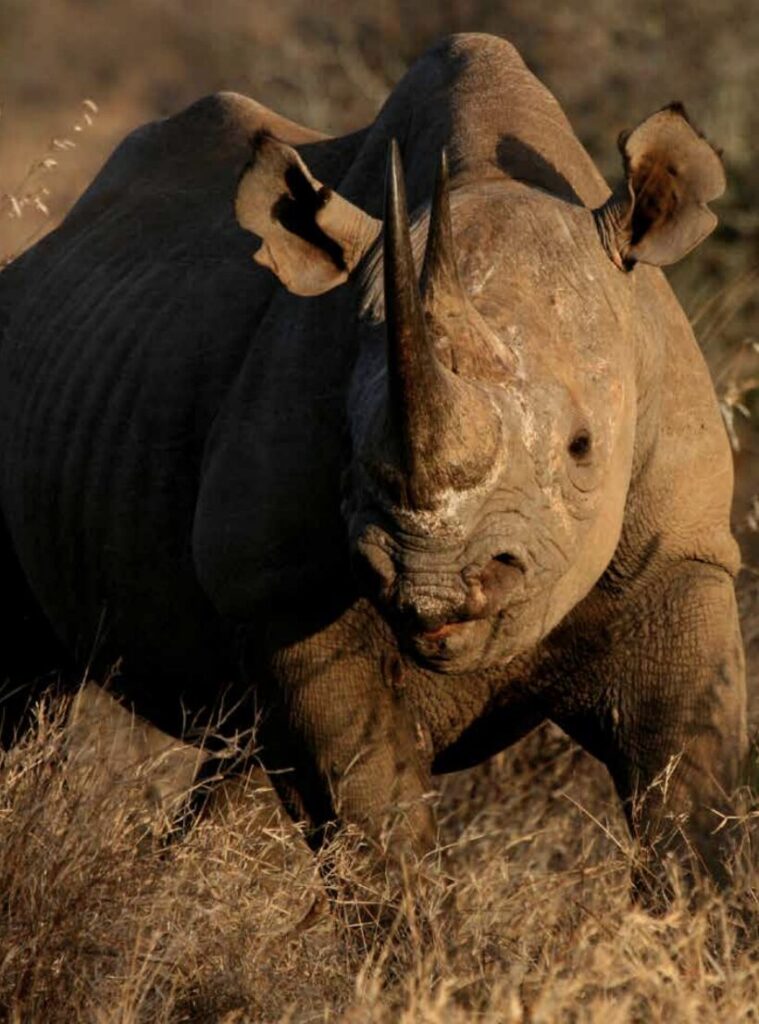
During a Nairobi National Park game drive, this means:
| Feature | Black rhino | White rhino |
|---|---|---|
| Mouth shape | Hooked, pointed upper lip | Broad, square mouth |
| Feeding style | Browses shrubs, twigs and leafy plants | Grazes grass |
| Head posture | Often held higher | Often carried lower |
| Body impression | Smaller, more compact, less heavy-necked | Larger, heavier, more rectangular |
| Habitat use | Thickets, shrub edges, broken cover | More open grassland and short-grass areas |
| Safari behaviour | Often more alert, secretive or reactive | Often calmer and easier to watch in open areas |
From a vehicle, the lip is not always easy to see. When the animal is partly hidden, facing away or standing in shade, guides combine several clues: habitat, head carriage, body outline, feeding movement and behaviour.
Why black rhinos are not actually black
Black rhinos are not truly black, and white rhinos are not truly white. Both African rhino species are usually grey, with colour affected by mud, dust, soil, wallowing and local ground conditions. Save the Rhino notes that there is no real colour difference between black and white rhinos; both are dark grey, and their apparent colour varies with local soil and wallowing behaviour.
This matters in Nairobi National Park because soil, dust, wet mud, seasonal grass and light conditions can make a rhino look darker, paler, reddish-brown or almost charcoal grey. A visitor who relies on colour alone will misidentify rhinos.
Use this rule instead:
- Do not identify by colour.
- Identify by lip shape, feeding style, posture, body form and habitat.
- Use colour only as a note on mud, dust or lighting.
The names “black” and “white” are therefore poor field labels. “Hook-lipped rhino” and “square-lipped rhino” are much better descriptions.
Black rhino body shape
A black rhino has a more compact, athletic, forward-ready body shape than a white rhino. It is still a massive animal, but beside a white rhino it usually looks shorter, tighter and less heavy through the neck and shoulder.
Black rhinos are the smaller of the two African rhino species. Save the Rhino gives adult male black rhinos at up to about 1,350 kg, adult females up to about 900 kg, and shoulder height around 1.6 metres. WWF gives a comparable weight range of 1,760–3,080 pounds and height around 5.2 feet.
Field clues from body shape
| Body clue | What to look for |
|---|---|
| Overall size | Smaller than a white rhino, though still very large |
| Neck and shoulder | Less pronounced shoulder hump than a white rhino |
| Head | Smaller relative to the body |
| Backline | Often less long and rectangular than a white rhino |
| Posture | More upright head carriage because it browses above ground level |
| Movement | Can look more agile, compact and reactive |
A white rhino often looks like a heavy grazing machine: long-bodied, broad, low-headed and strongly built through the neck. A black rhino looks more like a browser built for reaching into shrubs, turning through bush and feeding in broken vegetation.
The hooked upper lip and browsing adaptation
The black rhino’s hooked upper lip is one of the clearest examples of form matching function. It is not a decorative feature. It is a feeding tool.
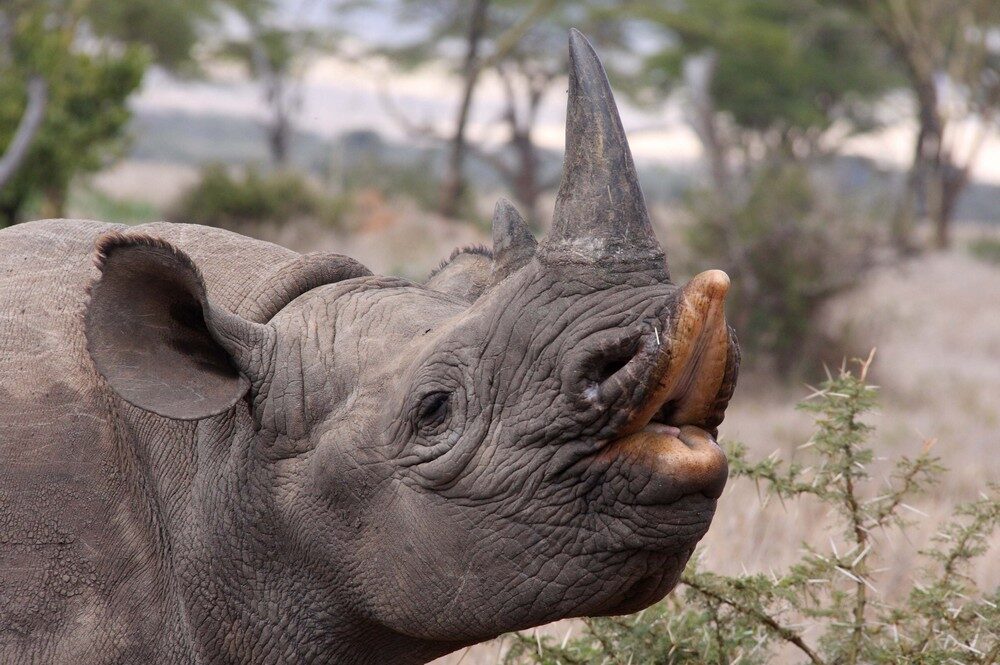
Black rhinos browse. They feed on leafy plants, twigs, shoots, shrubs and woody vegetation. Their pointed, prehensile upper lip allows them to pull vegetation into the mouth with more precision than a broad grazing mouth would allow. Save the Rhino describes black rhinos as browsers that feed from trees, bushes and shrubs, and notes that their hooked lip is tied directly to this feeding style.
During a game drive, watch the mouth when the rhino feeds. A black rhino often appears to:
- pluck leaves from shrubs;
- pull at twigs;
- browse from the side of bushes;
- feed with the head raised;
- move through thicket edges rather than keeping its muzzle down in grass.
The feeding sign can sometimes be clearer than the animal. Black rhinos can leave sharply bitten woody stems, unlike elephants, which often shred and break branches more roughly. Save the Rhino describes black rhino feeding cuts as clean-angled, almost pruning-shear-like marks on woody material.
Black rhino horn shape
Black rhinos have two horns. The front horn is usually longer than the rear horn, and both horns are made of keratin. Horn shape varies between individuals and can be affected by age, sex, wear, fighting, breakage, growth pattern and past injury. WWF and Save the Rhino both note that black rhino horns grow continually from the skin at their base, with the front horn generally longer than the rear horn.
What visitors can notice
| Horn feature | Interpretation |
|---|---|
| Long, narrow front horn | Often seen in females, but not definitive |
| Thick, heavy horn | Often associated with males, but not always reliable |
| Broken or split horn | May result from fighting, wear or injury |
| Uneven horn profile | Can help guides recognize individuals |
| Worn horn tip | May reflect age, rubbing, digging, fighting or repeated use |
| Rear horn size | Useful in combination with front horn shape |
Horn shape should not be used alone to identify sex or individual identity. It is one clue among many.
For guides, horn condition can be useful because rhinos often have individually recognizable horn profiles. A guide who knows the park well may notice whether a rhino has a chipped front horn, unusually straight horn, curved horn, short rear horn, thick base, worn tip or asymmetry. In a monitored rhino sanctuary, individual identification is usually much more systematic than casual horn recognition, but horn shape remains an important visual clue during game drives.
Black rhino ears
Black rhinos have prominent, mobile ears. Their eyesight is relatively poor, but their hearing and smell are strong. Save the Rhino notes that black rhinos, like white rhinos, have poor eyesight but excellent smell and hearing.
A guide watches the ears because they reveal what the rhino is paying attention to.
| Ear position | Possible meaning |
|---|---|
| Ears relaxed and rotating slowly | The rhino is monitoring its surroundings but not alarmed |
| Ears directed toward the vehicle | The rhino has noticed the vehicle |
| Ears stiff, forward and paired with raised head | Alert or assessing |
| Ears flicking rapidly with body tension | Irritation, insects or increasing stress |
| Ears pinned or held with tense posture | Possible agitation; guide should avoid pressure |
Ear position should be read together with head angle, feet, tail, breathing, movement and whether the rhino continues feeding.
Black rhino skin folds and colour
Black rhinos have thick grey skin, but the visible colour changes with dust, mud and wallowing. Hair is limited mostly to the ears, tail tip and eyelashes. Save the Rhino notes that black rhinos and white rhinos are both dark grey and that local soil and wallowing can change how their skin appears.
The skin can show wrinkles, scars, mud patches, rub marks and healed injuries. These details matter for photo interpretation and individual recognition.
What skin condition may show
| Skin feature | Possible explanation |
|---|---|
| Dry grey skin | Normal, especially in dry weather |
| Mud coating | Wallowing or cooling behaviour |
| Dusty reddish tone | Local soil and dust |
| Scratches and scars | Thorn vegetation, rubbing or fighting |
| Smooth wet patches | Recent wallowing or rain |
| Thick folds around joints | Normal rhino anatomy |
Do not over-interpret every scar. Rhinos live in thorny and abrasive habitats, and superficial marks are common. Deep wounds, limping, swelling or abnormal discharge would be a veterinary concern, but ordinary skin wear is part of rhino life.
Black rhino tail and posture
The tail is often overlooked, but it helps with behavioural interpretation. A relaxed rhino may let the tail hang naturally or flick it casually. A tense rhino may lift or stiffen the tail, especially if it is preparing to move, turn, defecate or react.
Posture matters even more.
| Posture | Likely interpretation |
|---|---|
| Head down into shrubs, feeding steadily | Relaxed browsing |
| Head raised, ears forward | Alert, assessing |
| Body side-on, still feeding | Comfortable if the rhino keeps eating |
| Body facing vehicle, head high | Caution; guide should not move closer |
| Sudden turn toward vehicle | Possible stress or defensive reaction |
| Short rush, snort or stamp | Warning; the vehicle is too intrusive |
Black rhinos can react quickly. Save the Rhino records that black rhinos can run fast and change direction surprisingly quickly, including through scrub and bushes.
For visitors, the key lesson is simple: a black rhino does not need to charge to show discomfort. A good guide reads smaller signs long before that point.
Black rhino size and weight
A black rhino is smaller than a white rhino, but it is still one of the largest mammals in Nairobi National Park. Adult males can weigh over a tonne, and even females are extremely powerful. Save the Rhino gives adult males up to 1,350 kg and adult females up to 900 kg; WWF gives the species weight range at about 1,760–3,080 pounds.
For field recognition, size is useful only when black and white rhinos can be compared directly. A single rhino standing alone can look enormous regardless of species.
Use size carefully:
- A very large, long-bodied, low-headed rhino in open grassland is more likely a white rhino.
- A more compact rhino feeding in shrubs with a higher head posture is more likely a black rhino.
- A subadult white rhino can look deceptively similar in size to an adult black rhino.
- Distance, grass height and vehicle angle can distort size.
The mouth remains the better clue.
Black rhino vs white rhino appearance
The easiest visitor mistake in Nairobi National Park is assuming that all rhinos seen in the park are black rhinos. Nairobi has both black and white rhinos, so the distinction matters. KWS lists both black and white rhino among the park’s common animal species.
| Feature | Black rhino | White rhino |
|---|---|---|
| Lip | Hooked, pointed, prehensile | Broad, square |
| Feeding | Browser | Grazer |
| Head posture | Higher | Lower |
| Body size | Smaller African rhino | Larger African rhino |
| Neck hump | Less pronounced | More pronounced |
| Habitat | Shrub, thicket, woodland edge, broken cover | Open grassland and grazing lawns |
| Temperament impression | Often more alert and secretive | Often calmer and more visible |
| Visibility | Often partly hidden | Often easier to see in open areas |
| Photo angle | May appear through branches or cover | Often clearer side-on views |
A useful field phrase is:
Black rhino = hook-lipped browser. White rhino = square-lipped grazer.
That phrase is more reliable than the colour names.
Black rhino vs white rhino mouth shape
The mouth is the most diagnostic visible feature.
A black rhino’s mouth is narrower and pointed because the upper lip hooks downward. The lip acts almost like a grasping tool. A white rhino’s mouth is wide and flat, built to crop grass close to the ground.
From a safari vehicle, the mouth is easiest to see when:
- the rhino is feeding side-on;
- the head is raised;
- the animal is close enough for binoculars;
- the rhino turns slightly toward the vehicle;
- the guide stops at a respectful angle rather than directly behind it.
Use binoculars. The lip is a small feature on a large animal, and many misidentifications happen because visitors rely on body colour or horn shape instead of the mouth.
Black rhino vs white rhino feeding style
Feeding behaviour is often easier to see than mouth shape.
| Feeding clue | Black rhino | White rhino |
|---|---|---|
| Head position | Raised toward bushes or shrubs | Low to the ground |
| Food type | Leaves, twigs, shoots, shrubs | Grass |
| Movement | Browses from plant to plant | Grazes steadily across open grass |
| Feeding mark | Clean cuts on woody twigs | Cropped grass |
| Habitat | Bushy edge or thicket | Open grazing area |
In Nairobi National Park, a rhino feeding in shrub cover with its head lifted into branches should immediately make a guide think “black rhino.” A rhino with its head down cropping grass across an open plain is more likely a white rhino.
Black rhino vs white rhino behaviour
Black rhinos often appear more alert, more solitary and more reactive than white rhinos. This is not because they are “bad-tempered” in a cartoon sense. It reflects their ecology. They are browsers that often use cover, rely heavily on smell and hearing, and may live more solitary territorial lives depending on habitat.
Save the Rhino describes black rhinos as ranging from solitary and territorial to semi-social depending on habitat, with scent marking through dung piles, urine spraying and rubbing.
White rhinos are often more visible in open landscapes and may be seen grazing in small groups. Black rhinos are more likely to be encountered as individuals or as a mother-calf pair in cover or near shrubland.
For visitors, this affects safari quality:
- black rhino sightings may be shorter;
- the animal may be partly hidden;
- the guide may keep more distance;
- close approach is not the goal;
- a calm sighting is better than a forced sighting.
Black rhino vs white rhino habitat preference
Black rhinos prefer habitat with browse: shrubs, woody plants, thickets, wooded edges, riverine vegetation and broken cover. White rhinos are grazers and are more associated with grassland.
Save the Rhino notes that black rhinos occur in habitats where shrubs, woody herbs, plant-life, water and mineral licks are available, including savannah, woodland, forest and wetland settings. WWF also describes black rhino habitats as semi-desert savanna, woodlands, forests and wetlands.
In Nairobi National Park, black rhino habitat recognition should be tied to the park’s mosaic:
- thickets;
- shrubland;
- woodland edges;
- drainage lines;
- bushy slopes;
- areas with cover near water;
- mixed vegetation where browsing is possible.
This does not mean black rhinos never appear in open areas. They can cross roads, use grassland edges and move through open ground. But if the animal is feeding like a browser in broken cover, black rhino becomes the stronger field interpretation.
How to identify a black rhino calf
A black rhino calf is smaller, rounder and proportionally softer-looking than an adult. Calves may have shorter horn development, smoother body lines and a more dependent movement pattern around the mother.
Save the Rhino notes that black rhino calves weigh around 30–45 kg at birth, can usually stand within the first few hours, and may remain with their mother for two to four years before separation.
Field clues for calves
| Calf clue | What it means |
|---|---|
| Stays close to one adult | Usually mother-calf pair |
| Moves behind or beside the adult | Protective positioning |
| Short or undeveloped horn | Young age |
| Playful or uncertain movement | Young calf or subadult behaviour |
| Adult becomes alert near vehicles | Mother is monitoring risk |
| Calf partly hidden in cover | Normal protective behaviour |
Visitors should be especially careful around cow-calf sightings. A mother black rhino may become defensive if a vehicle blocks her route, separates her from the calf, or crowds her in thick cover. The best guide keeps the vehicle still, quiet and non-threatening.
Male vs female black rhino identification
Sexing black rhinos from a vehicle is not always easy. Guides may use body size, horn shape, behaviour, calf association and visible anatomy, but several of these clues can be unreliable unless the view is clear.
Save the Rhino notes that horn shape can differ between sexes, with males tending to have thicker horns and females often having longer, thinner horns.
| Clue | Male black rhino | Female black rhino |
|---|---|---|
| Body build | Often heavier, more robust | Often slightly lighter |
| Horn | May be thicker | May be longer and slimmer |
| Behaviour | Territorial marking may be more obvious | Often seen with calf |
| Association | More often alone | May be with calf or subadult |
| Reliable anatomy | Only visible from certain angles | Only visible from certain angles |
The most practical field rule is: do not overclaim sex unless the evidence is clear. A guide can say “likely male” or “likely female” based on horn, body and behaviour, but confident identification often requires known individual records or clear visual confirmation.
Adult black rhino vs subadult black rhino
A subadult black rhino can confuse visitors because it may be large enough to seem adult but still smaller, less filled-out and sometimes more uncertain in movement or social position.
| Feature | Subadult | Adult |
|---|---|---|
| Body | Smaller, less heavily developed | Fully built, more muscular |
| Horn | Shorter or still developing | Larger and more worn |
| Behaviour | May be more exploratory or subordinate | More established behaviour |
| Social position | May still be near mother or recently independent | More independent, territorial or reproductive |
| Field confidence | Often difficult without guide knowledge | Easier if size and horn development are clear |
Subadult bulls can be especially interesting from a conservation point of view because territorial pressure matters in rhino sanctuaries. Young males eventually need space, and in a compact park, social pressure can affect movement, conflict and management decisions.
Rhino tracks in Nairobi National Park
Rhino tracks are valuable field signs, especially where the animal has passed before the vehicle arrives. Rhino footprints are large, rounded and three-toed. Save the Rhino notes that all rhino species have three toes, with three stout nails leaving impressions around a softer wrinkled sole, and that the front feet are larger than the back feet.
What guides look for in rhino tracks
| Track feature | Interpretation |
|---|---|
| Large round print | Rhino-sized animal |
| Three toe impressions | Rhinoceros foot structure |
| Bigger front print | Normal rhino track pattern |
| Direction of travel | Helps guide predict movement |
| Fresh edge in dust or mud | Recent passage |
| Overlapping tracks | Frequently used route |
| Tracks near dung midden | Active rhino communication area |
In Nairobi National Park, tracks can be clearest after rain, in soft dust, on road edges, around water points, near thickets or along frequently used animal paths.
Tracks should never be used to disturb or pressure rhinos. A good guide uses tracks to interpret movement, not to chase animals into cover.
Rhino dung middens
A midden is a repeated dung deposit site used for scent communication. Black rhinos use dung middens as part of their social and territorial system. Save the Rhino describes dung piles as common scent marks and notes that black rhinos may defecate repeatedly in one spot or distribute dung piles across a home range.
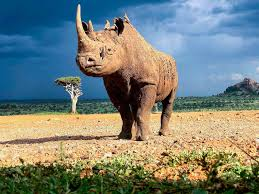
What a rhino midden tells a guide
| Midden clue | Possible meaning |
|---|---|
| Repeated dung piles | Regular rhino use |
| Fresh dung | Recent activity |
| Scattered dung | Kicking and scent spreading |
| Tracks around midden | Movement route |
| Plant fragments in dung | Browsing diet |
| Multiple deposits | Communication point |
Dung middens are not just “animal waste.” They are rhino noticeboards. They carry information about presence, territory, reproductive condition and movement. For visitors, a midden is one of the strongest signs that a rhino area is active even when no rhino is visible.
Rhino browsing signs
Black rhinos leave feeding signs on shrubs and woody plants. Because they browse with a hooked lip and bite off woody material, the cut can look cleaner than damage caused by elephants. Save the Rhino notes that black rhinos often leave a clean-angled, pruning-shear type edge on woody plant material, and that traces of woody material may also appear in dung.
Signs of black rhino browsing
- cleanly bitten twigs;
- clipped shrub ends;
- broken but not shredded woody stems;
- feeding paths through thicket;
- repeated browsing at shoulder height;
- dung containing woody fragments;
- tracks near browsed vegetation.
In Nairobi National Park, browsing signs help a guide explain the rhino even when the sighting is brief. The landscape itself carries evidence of rhino presence.
Rhino horn condition and individual recognition
Horn condition can help guides recognize individual rhinos, especially when combined with ear notches, scars, body condition, preferred area, behaviour and known sighting history.
A rhino’s horn may be:
- long and straight;
- curved backward;
- thick at the base;
- thin and pointed;
- chipped;
- broken;
- split;
- worn down;
- asymmetrical.
Horn condition changes over time because horns grow, wear, break and recover. Save the Rhino explains that rhino horns grow continually and can break or split during fighting.
For serious monitoring, horn shape alone is not enough. In a formal rhino sanctuary, reliable identification may also involve ear-notching, photographic records and individual monitoring files. During a visitor game drive, however, horn condition is one of the visible clues a guide may use to explain why a particular rhino looks recognizable.
How guides identify individual rhinos
Experienced Nairobi National Park guides do not identify rhinos only by species. When they know the park well, they may begin to recognize individual animals or at least narrow identification based on consistent features.
Field features used for individual recognition
| Feature | How it helps |
|---|---|
| Horn shape | Length, curve, breakage, thickness |
| Ear shape or notches | Formal or natural identification marks |
| Scars | Old injuries, skin marks, fighting marks |
| Body size | Adult, subadult, male, female |
| Calf association | Known cow-calf pair |
| Behaviour | Shy, tolerant, territorial, frequently seen |
| Area use | Repeated presence in a known habitat zone |
| Gait | Limp, stiffness or distinctive movement |
| Skin marks | Mud patterns are temporary; scars are more reliable |
A guide should be careful not to pretend certainty where there is none. Good field interpretation often uses qualified language: “This may be the same cow we saw last week,” or “The horn profile looks familiar,” or “This individual appears to be a subadult rather than a fully mature bull.”
That honesty builds trust. Rhino identification is skilled work, not guesswork.
How to tell if a black rhino is relaxed, alert or stressed
This is one of the most important skills for a rhino-focused Nairobi National Park safari. A black rhino’s behaviour tells the guide how close the vehicle should remain, whether to stop, whether to reverse, and whether the sighting should be left alone.
Field behaviour table
| State | What visitors may see | What the guide should do |
|---|---|---|
| Relaxed | Feeding continues, ears rotate normally, body stays loose, rhino does not fixate on vehicle | Stop quietly, keep distance, avoid sudden movement |
| Mildly alert | Head lifts, ears point toward vehicle, rhino pauses feeding | Stay still, avoid moving closer |
| Assessing | Rhino faces vehicle, stands still, watches, may sniff or listen | Give space, keep engine noise low, avoid blocking path |
| Irritated | Tail movement increases, head toss, short steps, snorting, foot movement | Move away slowly or stop pressuring the animal |
| Stressed | Sudden turn, direct approach, repeated snorts, short rush, calf shielded by mother | Withdraw calmly; sighting has been pushed too far |
| Defensive | Cow blocks calf, rhino faces vehicle repeatedly, agitation increases | Leave the area responsibly |
A relaxed rhino is the best rhino sighting. Visitors sometimes think the best sighting is the closest one. In a rhino sanctuary, the better standard is different: the best sighting is one where the animal keeps behaving naturally.
What a relaxed rhino looks like
A relaxed black rhino may continue feeding, walk slowly, pause briefly, flick its ears, breathe normally and show no urgent need to move away. Its body remains loose rather than stiff. If it notices the vehicle but resumes browsing, that is usually a good sign.
A relaxed sighting gives visitors time to notice details:
- the hooked lip pulling vegetation;
- the horn profile;
- ears rotating to sound;
- skin texture and scars;
- feeding height;
- calf position if present;
- the habitat it has selected.
This is the type of sighting Kifaru Ark should encourage: calm, interpretive and respectful.
What an alert rhino looks like
An alert black rhino may lift its head, stop feeding, turn its ears toward the vehicle and hold still. It may not be frightened, but it is assessing.
At this point, the guide should not push closer. The rhino is already telling the vehicle that it has been noticed.
Visitor interpretation:
- raised head does not automatically mean aggression;
- direct attention means the rhino is evaluating risk;
- silence in the vehicle helps;
- the guide should leave the rhino a clear escape route;
- blocking the road or crowding the animal can turn alertness into stress.
What a stressed black rhino looks like
A stressed black rhino may snort, toss its head, stamp, swing its body toward the vehicle, move abruptly, shield a calf, or make a short rush. The moment these signs appear, the safari has shifted from viewing to disturbance.
A trained guide should respond before the situation escalates. Black rhinos are powerful, fast and capable of changing direction quickly. Save the Rhino notes that black rhinos can run extremely fast and move through scrub and bushes.
Stress is not good safari drama. It is a sign that the animal’s space has been mishandled.
How protection affects rhino viewing in Nairobi National Park
Because Nairobi National Park is a rhino sanctuary, rhino viewing is shaped by protection. Visitors may notice that guides are careful about how they describe rhino locations, how close they approach, and how long they remain near a sensitive individual. This is not a weakness of the safari. It is part of responsible rhino tourism.
The park’s rhino protection work is visible through controlled routes, ranger presence, boundary infrastructure, monitoring culture and guide caution around rhino sightings. KWS has also referred to Nairobi National Park’s rhino Monitoring and Protection Unit, showing that rhino protection is a dedicated function within the park’s conservation work.
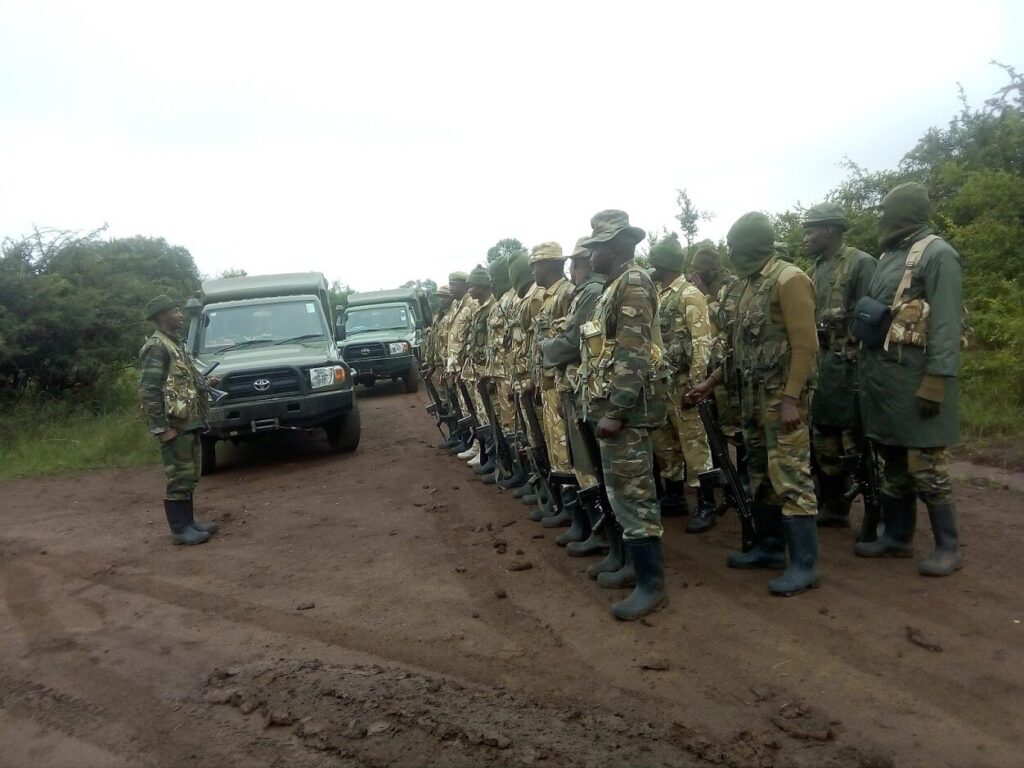
For visitors, this may affect the experience in two ways:
| Visitor expectation | Conservation reality |
|---|---|
| “I want the closest possible rhino photo.” | The guide may keep distance to avoid stressing the animal. |
| “Why not follow it into the bushes?” | Black rhinos need cover, and pressuring them into thicket is poor guiding. |
| “Why not share exact rhino locations?” | Rhino location information can be sensitive. |
| “Why did the guide leave while we could still see it?” | A calm exit may protect the animal and preserve the quality of the sighting. |
| “Why are some rhino sightings brief?” | Black rhinos often use cover and may not remain exposed. |
A Kifaru Ark rhino safari should teach visitors that respectful distance is not a missed opportunity. It is the correct way to view a critically important animal.
Photo interpretation: what to capture when photographing black rhinos
Good black rhino photography in Nairobi National Park is not only about a horn close-up. The strongest images often show the animal’s ecological identity.
Useful photo angles include:
- side profile showing compact body shape;
- close enough view of the hooked lip, without crowding;
- browsing behaviour in shrubland;
- mother and calf at respectful distance;
- rhino partly framed by Nairobi National Park habitat;
- horn condition and ear profile;
- relaxed posture rather than stress behaviour;
- habitat context, not only animal portrait.
Avoid photographs created through pressure. A rhino looking tense, cornered, crowded or blocked by vehicles is not a successful image. It is evidence of poor field conduct.
Field-recognition summary for visitors
Use this quick hierarchy during a Nairobi National Park game drive:
- Check the mouth. Hooked lip means black rhino; square mouth means white rhino.
- Watch the feeding style. Browsing shrubs points to black rhino; grazing grass points to white rhino.
- Read the posture. Higher head carriage suggests black rhino; low grazing posture suggests white rhino.
- Look at habitat. Thickets and shrub edges often favour black rhino; open grassland often favours white rhino.
- Use body shape carefully. Black rhinos are smaller and more compact, but distance can mislead.
- Do not use colour. Both species are grey, and mud or dust changes appearance.
- Read behaviour. A calm rhino is a better sighting than a pressured rhino.
- Ask your guide about signs. Tracks, dung middens and browsing marks often reveal rhino activity before the animal appears.
Kifaru Ark field perspective
To identify a black rhino in Nairobi National Park, do not begin with colour. Begin with ecology. A black rhino is a hook-lipped browser built for shrubs, thickets, woody plants and broken cover. Its mouth, posture, habitat choice and feeding signs tell the story more clearly than its name.
For visitors, learning these details changes the safari. A rhino is no longer just a large grey animal with a horn. It becomes a readable conservation subject: a browser, a territorial animal, a monitored individual, a mother with a calf, a moving part of Nairobi National Park’s rhino sanctuary, and a living symbol of why Kifaru Ark matters.
The best black rhino sighting is not the closest one. It is the one where the animal remains calm, the guide interprets what is happening, and the visitor leaves with a better understanding of how to see rhinos without turning protection into disturbance.