
Ethical black rhino viewing in Nairobi National Park means keeping respectful distance, staying on the road, remaining quiet, avoiding crowding, giving rhinos the right of way, and never treating a rhino as a photo prop. KWS park rules tell visitors to respect wildlife’s “privacy and right of way,” move slowly and quietly, remain in vehicles except at designated places, stay on established roads, avoid off-road driving, and view wildlife from respectful distances with a recommended minimum distance of 20 metres.
Kifaru Ark treats black rhino viewing as part of conservation, not only tourism. Nairobi National Park protects a sensitive rhino population inside a busy urban-edge park, so visitor behaviour matters. A calm sighting helps the animal continue feeding, resting or moving naturally. A pressured sighting teaches the wrong lesson: that endangered wildlife exists to satisfy vehicle positioning, camera angles or social-media expectations.
| During a black rhino sighting | Do this | Avoid this |
|---|---|---|
| Vehicle position | Stop at a respectful distance and leave the rhino a clear path | Block the road, edge closer, or surround the animal |
| Noise | Keep voices low and phones quiet | Shout, clap, whistle, hoot, or play sounds |
| Photography | Photograph from the vehicle without disturbing the animal | Force a reaction for a better pose |
| Rhino movement | Let the rhino cross, feed, rest or retreat naturally | Follow it into thicket or cut off its route |
| Calves | Give mother-and-calf pairs extra space | Position the vehicle between mother and calf |
| Location sharing | Share general conservation stories | Post exact real-time rhino locations |
How close should vehicles get to black rhinos?
Safari vehicles should keep at least the KWS recommended minimum viewing distance of 20 metres, and they should stay farther back when a black rhino appears alert, boxed in, accompanied by a calf, feeding near cover, or moving toward a road. The KWS park rules give 20 metres as the recommended minimum distance for wildlife viewing, but black rhinos often deserve a wider margin because they are powerful, sensitive, and more reactive than many open-plains animals.
A 20-metre distance is not a target to push toward. It is a minimum rule. A good guide reads the animal first, then chooses the distance. A relaxed rhino feeding in open view may tolerate a stationary vehicle at a safe distance. A cow with a calf in thicket may need much more space. A rhino facing the vehicle with raised head and fixed attention is already telling the guide that the vehicle has become part of its awareness.
Black rhino viewing should follow this hierarchy:
- Animal comfort first — the rhino should remain relaxed.
- Right of way second — the rhino must have a clear route to move.
- Vehicle safety third — the guide must avoid risky angles.
- Photography last — the photo should never drive the approach.
Why guides keep distance from black rhinos
Guides keep distance from black rhinos because black rhinos have poor eyesight, strong hearing and smell, territorial behaviour, and a quick defensive response when they feel uncertain. Save the Rhino notes that black rhinos have poor eyesight but excellent smell and hearing, and that they may not easily detect an observer standing more than 30 metres away. The same source records that black rhinos can move very fast, change direction quickly, and run through scrub and bushes.
Distance gives the rhino time to identify the vehicle as non-threatening. Distance also gives the guide time to interpret the animal’s posture, ear position, movement direction and level of stress.
A close vehicle can create several problems:
- The rhino may feel trapped.
- The rhino may stop feeding.
- The rhino may turn toward the vehicle to assess the threat.
- The rhino may retreat into cover before visitors can observe natural behaviour.
- A cow may become defensive around a calf.
- Several vehicles may copy the first vehicle and create a crowd.
A skilled guide does not measure success by closeness. A skilled guide measures success by how naturally the rhino behaves while being observed.
What is a safe rhino viewing distance?
A safe rhino viewing distance is the distance at which the rhino continues normal behaviour and the vehicle does not affect its movement, feeding or resting. The KWS rule gives a recommended minimum distance of 20 metres, but black rhino safety often requires a larger buffer depending on terrain, vegetation, calf presence and the rhino’s mood.
Use this field guide:
| Rhino behaviour | What it suggests | Better vehicle response |
|---|---|---|
| Feeding steadily | Relaxed | Stop quietly and keep the current distance |
| Lifting head briefly, then feeding again | Aware but comfortable | Stay still and avoid moving closer |
| Facing the vehicle with ears forward | Alert | Give more space |
| Walking toward the road | Preparing to cross or investigate | Stop and leave the road clear |
| Moving into thicket | Seeking cover | Do not follow |
| Snorting, head tossing, stamping | Irritated or defensive | Reverse calmly or leave |
| Cow shielding calf | Protective concern | Increase distance immediately |
A rhino that stays calm gives you a better sighting. A rhino that reacts to the vehicle has already been pushed too far.
Why vehicles should stay on the road
Safari vehicles should stay on established roads because off-road driving damages habitat, disturbs wildlife, creates unsafe viewing angles and violates KWS park rules. KWS states that vehicles and bikes should stay on established roads and trails, and that off-road driving is strictly prohibited.
Off-road driving is especially damaging around black rhinos because rhino habitat often includes thickets, grassland edges, drainage lines, riverine cover and fragile soil. A vehicle leaving the track can crush vegetation, widen unofficial tracks, disturb resting animals, expose calves, and encourage other drivers to follow.
Nairobi National Park is small and heavily visited. One vehicle off-road can quickly become several vehicles off-road. A single bad decision can turn a calm rhino sighting into pressure, dust, noise and habitat damage.
Kifaru Ark guiding should be strict on this point: a rhino sighting is not permission to leave the road.
Why vehicles should not surround a rhino
Vehicles should not surround a black rhino because a surrounded animal loses escape options and may become defensive. A rhino needs a clear route to move away from people, other vehicles, thickets, calves or social pressure from other rhinos.
Surrounding a rhino creates several avoidable risks:
- The rhino may feel trapped.
- The animal may choose a direct path through vehicles.
- A cow may struggle to move her calf safely.
- The sighting may escalate into horn-pointing, snorting or a short rush.
- Other drivers may crowd in because they assume the first vehicles are behaving correctly.
Responsible guiding uses a one-sided viewing angle whenever possible. Vehicles should observe from a respectful position and leave the animal’s front, rear or side route open depending on its movement. A guide should never create a ring of vehicles around a black rhino.
Why vehicles should not block a rhino’s path
Vehicles should not block a rhino’s path because the rhino has the right of way and must be allowed to move naturally. KWS begins its park rules with a direct reminder: visitors are in the wildlife’s home and should respect wildlife privacy and right of way.
A blocked rhino may stop, stare, toss its head, turn suddenly, push through cover, or move toward the vehicle. Black rhinos are not trying to entertain visitors when they approach a road. They may be crossing between browse patches, moving toward water, following a familiar path, avoiding another rhino, or keeping a calf close.
The correct response is simple:
- Stop early.
- Keep quiet.
- Leave a clear crossing route.
- Avoid driving parallel to the rhino.
- Wait until the animal has fully passed.
- Continue only when the guide is sure the rhino is calm.
A rhino crossing the road is one of the best moments in a Nairobi National Park safari, but only when the vehicle does not turn the crossing into pressure.
Why guides should not follow black rhinos into thick cover
Guides should not follow black rhinos into thick cover because thickets are feeding, resting, hiding and calf-protection areas. A black rhino entering cover is often choosing privacy. The vehicle should respect that choice.
Thick cover changes the safety equation. Visibility drops. The guide may lose sight of the rhino’s body position. A calf may be hidden. Another rhino may be nearby. The road may narrow. The animal may feel pursued.
Following a black rhino into cover creates poor safari practice for three reasons:
- Animal welfare declines because the rhino loses its refuge.
- Vehicle safety declines because the guide cannot read the animal clearly.
- Conservation interpretation declines because visitors learn pursuit instead of respect.
A good guide may stop at the edge, explain why the rhino is using cover, look for tracks or browsing signs, and then leave the area quietly.
Why rhino calves require extra caution
Rhino calves require extra caution because a mother black rhino may become defensive when vehicles crowd her, block her route, or separate her from the calf. Black rhino calves stay with their mothers for years, and Save the Rhino notes that calves may remain with the mother for 2–4 years before separation, usually when the female is ready to calve again.
A cow-and-calf sighting should be treated as a sensitive conservation moment. The guide should avoid tight angles, sudden repositioning, vehicle noise and any placement that puts the vehicle between mother and calf.
Mother-and-calf sightings need these rules:
- Keep more than the normal minimum distance.
- Stay behind the guide’s chosen line.
- Do not call out to the calf.
- Do not pressure the mother for a clear view.
- Leave the road open.
- Allow the pair to enter cover.
- End the sighting early when the mother becomes alert.
A calm cow-and-calf sighting is more valuable than a close photograph. Calf survival is part of the sanctuary’s future, and visitor behaviour should support that.
How a trained guide reads black rhino behaviour
A trained guide reads black rhino behaviour through posture, ears, head angle, movement, feeding rhythm, tail position, calf placement and reaction to the vehicle. The guide should make decisions before the animal becomes visibly stressed.
Black rhino behaviour often changes in stages:
| Behaviour stage | Field sign | Guiding decision |
|---|---|---|
| Relaxed | Feeding continues, ears rotate naturally, body remains loose | Stop quietly and interpret the sighting |
| Aware | Head lifts, ears orient toward the vehicle, feeding pauses | Stay still and avoid closing distance |
| Alert | Rhino faces the vehicle, holds posture, sniffs or listens | Give space and keep the route open |
| Irritated | Snorting, head tossing, foot movement, tail tension | Increase distance or leave |
| Defensive | Short rush, repeated facing, cow shields calf | Withdraw calmly and end the sighting |
Black rhinos use scent and hearing heavily because their eyesight is poor. Save the Rhino notes that scent-marking through dung middens and urine spraying is important communication, and that sniffing and snorting are common sounds, especially when disturbed.
A guide who understands this does not wait for dramatic behaviour. The guide reads small changes early.
What should you do when a rhino approaches the road?
A rhino approaching the road should be given a clear, quiet crossing space. The guide should stop before the rhino reaches the road, avoid blocking the animal’s line, and wait until the rhino has crossed or changed direction calmly.
You should remain seated, keep your voice low, and avoid leaning out for a closer photograph. KWS advises visitors to remain in vehicles unless at designated areas and to keep doors closed.
A black rhino near the road may be doing one of several things:
- crossing between feeding patches;
- moving toward water;
- using a familiar path;
- avoiding another rhino;
- assessing vehicle presence;
- guiding a calf across;
- returning to cover.
A vehicle should not race ahead to “catch” the crossing. The guide should anticipate the movement and create a quiet gap.
What should you do when a rhino crosses in front of the vehicle?
A rhino crossing in front of the vehicle should be allowed to pass fully before the safari continues. The vehicle should stay still, remain quiet, and avoid sudden acceleration once the rhino has passed.
A proper crossing response looks like this:
- Stop with space on both sides of the rhino’s path.
- Keep the engine and voices low.
- Let the rhino decide the route.
- Avoid flash, shouting or clapping.
- Wait for any calf or second rhino.
- Continue slowly after the animal has moved away.
A crossing rhino often gives excellent photographs without pressure. The strongest images come from patience, not from forcing the animal to look at the vehicle.
How to behave during a black rhino sighting
Black rhino sightings require quiet, still and disciplined behaviour. KWS tells visitors to move slowly and quietly, because wild animals can react dangerously when startled; it also states that noise distracts wildlife from normal daily routines.
Good visitor behaviour is simple:
- Stay inside the vehicle.
- Keep your voice low.
- Keep doors closed.
- Avoid sudden standing or leaning.
- Let the guide position the vehicle.
- Avoid pressuring the guide to go closer.
- Keep phones quiet.
- Photograph without disturbing the animal.
- Leave the animal’s path open.
- Respect the guide’s decision to leave.
A rhino sighting is not the moment to debate distance, ask for risky positioning or compare your guide to another vehicle that is behaving badly. Responsible guiding sometimes means stopping farther away than other vehicles.
Why visitors should not shout, clap or whistle at rhinos
Visitors should not shout, clap, whistle or make sounds to attract a rhino’s attention because noise disturbs wildlife and can trigger alert or defensive behaviour. KWS specifically warns that noise distracts wildlife’s normal routine and tells visitors to use phones and sound devices sparingly.
Noise-based photography is poor practice. A rhino looking up because it has been disturbed is not a better image. It is a less ethical image.
Avoid these behaviours:
- clapping to make the rhino raise its head;
- whistling for eye contact;
- shouting “look here”;
- hooting from the vehicle;
- playing sounds from a phone;
- laughing loudly at close range;
- calling to a calf.
A calm rhino that keeps browsing is the better sighting. Natural behaviour is the goal.
Rhino photography ethics
Ethical rhino photography records natural behaviour without changing the animal’s behaviour. A good rhino photograph should not require crowding, noise, off-road driving, blocking, baiting, flash pressure or a forced reaction.
Kifaru Ark photography standards should be clear:
| Ethical photography | Poor photography |
|---|---|
| Photograph from the road | Ask the guide to drive off-road |
| Use a longer lens | Demand a closer approach |
| Wait for natural movement | Shout or clap for eye contact |
| Capture habitat context | Crop out signs of crowding and pressure |
| Keep locations general | Geotag exact rhino positions |
| Stop photographing when the animal becomes stressed | Keep shooting during obvious distress |
Good rhino photography often includes the habitat: thicket, grassland edge, riverine cover, browse, dust, skyline, or the careful space between vehicle and animal. That context tells a stronger conservation story than a tight horn photograph taken under pressure.
No drone use near rhinos
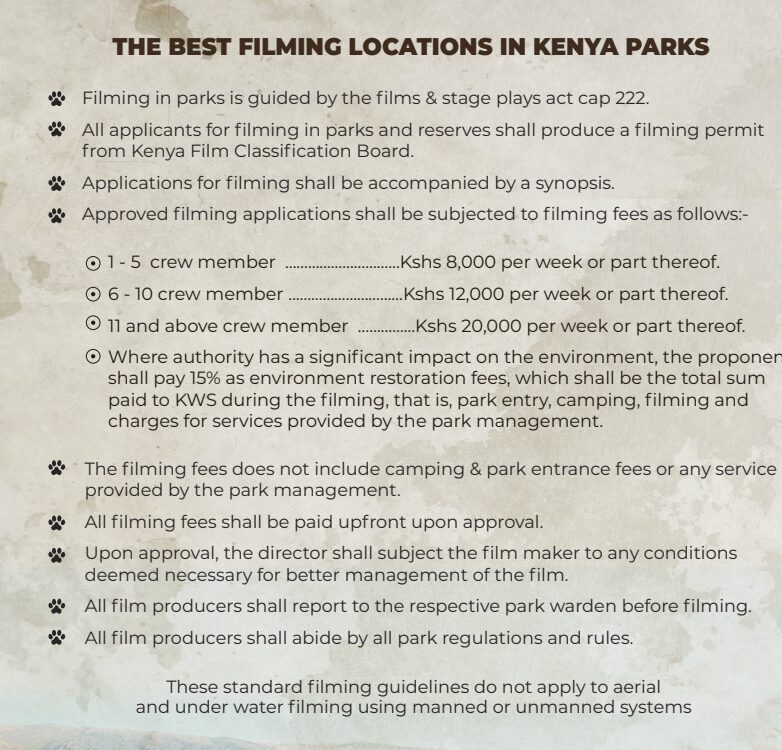
Drone use near rhinos should be treated as prohibited for normal visitors unless formal authorization has been granted by the relevant authorities. Kenya Civil Aviation Authority standards state that UAS operations require authorization, and the risk assessment for proposed operations includes restricted areas such as national parks or protected areas.
Drones are especially inappropriate around rhinos because they add noise, overhead movement and security risk. Rhinos may not understand the source of a drone. A cow with a calf may react defensively. A drone can also expose sensitive location information in a high-security species context.
The visitor rule is straightforward: do not bring or fly a drone for rhino viewing in Nairobi National Park unless you have formal, written approvals and the operation is professionally cleared. A normal safari booking is not drone permission. Below are details from the Kenya Film Commission on filming conditions in protected areas;
No geotagging sensitive rhino locations
Exact rhino locations should not be geotagged because black rhinos remain security-sensitive animals. A visitor can share that they saw rhinos in Nairobi National Park, but exact coordinates, real-time location pins, route descriptions and identifiable sensitive areas should not be posted publicly.
Responsible sharing looks like this:
- “We saw a black rhino in Nairobi National Park.”
- “The guide explained why rhino locations should be protected.”
- “The rhino was using thicket and grassland-edge habitat.”
Irresponsible sharing looks like this:
- posting GPS coordinates;
- naming exact rhino hotspots;
- sharing live locations in public groups;
- uploading maps showing cow-and-calf positions;
- describing ranger or patrol patterns;
- tagging a precise road bend or hidden rhino area.
A conservation-first rhino safari treats location restraint as part of protection.
Why black rhinos should not be treated like photo props
Black rhinos should not be treated like photo props because they are endangered, territorial, sentient animals living inside a protected sanctuary. A rhino sighting is a conservation encounter, not a staged attraction.
A photo-prop mindset produces bad guiding:
- vehicles close in until the animal reacts;
- guides angle the vehicle for the camera, not the animal;
- visitors shout for eye contact;
- drivers block movement paths;
- calves are exposed for photographs;
- the animal’s stress becomes “drama.”
A conservation mindset produces better guiding:
- the vehicle stops early;
- the rhino keeps feeding or moving naturally;
- the guide explains behaviour and habitat;
- the animal’s route remains open;
- visitors learn why distance matters;
- the sighting ends before pressure builds.
Kifaru Ark should set the second standard. Rhino tourism should make visitors more respectful, not more demanding.
Responsible rhino safari guiding
Responsible rhino safari guiding combines park-law compliance, field interpretation, animal welfare, vehicle discipline and conservation sensitivity. A responsible guide does not only find rhinos; the guide protects the quality of the encounter.
A responsible guide should:
- stay on roads;
- maintain distance;
- keep the vehicle quiet;
- read rhino behaviour before repositioning;
- avoid crowding;
- manage guest expectations;
- refuse unsafe photography requests;
- avoid real-time location exposure;
- give cow-and-calf pairs extra space;
- explain why black rhinos use cover;
- leave the sighting when pressure increases.
A guide’s professionalism becomes most visible when the guide says no. No to off-road driving. No to crowding. No to blocking. No to clapping. No to chasing into cover. No to exact-location posting.
That discipline is not anti-tourism. It is what makes rhino tourism credible.
Rhino welfare and visitor conduct
Rhino welfare depends on visitor conduct because repeated disturbance can change how animals use roads, thickets, water points and feeding areas. One careless vehicle may seem minor, but repeated pressure from many vehicles can affect the animal’s daily routine.
KWS park rules are built around this principle: visitors are in the wildlife’s home, animals have the right of way, noise distracts wildlife, visitors should remain in vehicles, vehicles should stay on established roads, and wildlife should be viewed from respectful distance.
A visitor contributes to rhino welfare by doing ordinary things well:
- sitting still;
- keeping quiet;
- trusting the guide;
- accepting distance;
- avoiding off-road pressure;
- not feeding wildlife;
- not littering;
- not geotagging exact locations;
- not comparing the guide to irresponsible vehicles.
Ethical behaviour is not complicated. It requires restraint.
Conservation-first rhino tourism
Conservation-first rhino tourism treats the rhino’s welfare and security as more important than the visitor’s closest possible view. Nairobi National Park can offer excellent rhino sightings, but the park’s value is deeper than photography. It protects black rhinos in a compact urban-edge sanctuary where visitor behaviour, ranger work, habitat pressure and public education all meet.
Conservation-first tourism improves the safari because it gives the sighting meaning. You do not only see a rhino. You learn why the guide keeps distance, why location sharing is sensitive, why thickets matter, why calves need space, why off-road driving is unacceptable, and why a calm animal is the strongest outcome.
This is the kind of rhino experience Kifaru Ark should promote: knowledgeable, restrained, respectful and honest about the conservation stakes.
Why respectful distance creates better sightings
Respectful distance creates better sightings because a relaxed rhino stays visible longer, behaves more naturally and gives visitors more to interpret. A pressured rhino often stops feeding, turns tense, retreats into cover or reacts defensively. Distance does not weaken the experience; it often improves it.
A relaxed black rhino may show you:
- browsing behaviour;
- hooked-lip feeding;
- scent-checking;
- ear movement;
- calf positioning;
- slow road crossing;
- habitat use;
- natural interaction with oxpeckers;
- movement between cover and open ground.
A stressed black rhino mainly shows you the consequences of poor vehicle pressure.
Kifaru Ark should teach visitors to value the calm sighting. The best rhino encounter is not the closest one. It is the encounter where the animal remains itself.
What visitors should ask their guide during a rhino sighting
Good questions help visitors understand black rhinos without pressuring the animal.
Useful questions include:
- “Is this rhino relaxed or alert?”
- “What signs show that it is comfortable?”
- “Is it browsing or moving between cover?”
- “Why are we stopping here rather than going closer?”
- “Does this area provide cover, browse or water access?”
- “Is it safe to take photos from here?”
- “Should we avoid sharing this location?”
- “Is this a black rhino or a white rhino, and how can we tell?”
Poor questions push the guide toward bad behaviour:
- “Can we go closer?”
- “Can you make it look up?”
- “Can you follow it into the bush?”
- “Can you move in front of it?”
- “Can you get us between it and the other car?”
A serious rhino safari rewards curiosity, not pressure.
Kifaru Ark perspective: the ethics are part of the sighting
Black rhino viewing in Nairobi National Park is not only about finding the animal. The way you view the rhino is part of the conservation story. A quiet vehicle, a respectful distance, a clear crossing path and a guide who refuses to crowd the animal all show you what rhino protection looks like during an ordinary game drive.
Kifaru Ark should frame every black rhino sighting through three linked ideas: welfare, security and interpretation. Welfare means the animal remains calm. Security means exact locations and sensitive behaviour are not exposed. Interpretation means visitors understand the rhino as a protected living animal, not as a checklist species.
Nairobi National Park gives visitors a rare chance to see rhinos close to a capital city. That access comes with responsibility. The strongest rhino safari is the one where the visitor leaves with a good sighting, a better understanding of black rhino behaviour, and a clear sense that respectful distance is not a limitation. It is the standard that keeps Kifaru Ark worthy of its name.