
Black rhino habitat in Nairobi National Park is defined by browse, cover, water access, terrain complexity, security and seasonal vegetation change. Black rhinos are not open-grassland grazers like white rhinos; they are hook-lipped browsers that use shrubland, thickets, dwarf-tree grassland, forest edges, riverine cover, dam-influenced vegetation and movement corridors where woody plants provide food and concealment. Nairobi National Park is unusual because this habitat mosaic sits inside a small urban-edge sanctuary beside Nairobi, where rhino ecology is shaped by natural vegetation, black cotton soils, river systems, fenced boundaries, visitor routes, habitat fragmentation and intensive protection.
KifaruArk.org treats Nairobi National Park as Kifaru Ark because the park is not merely a place where rhinos occur. It is a compact rhino sanctuary where black rhino survival depends on active protection, ecological monitoring, habitat quality and careful visitor conduct. The park’s management plan identifies black rhino as one of Nairobi National Park’s seven conservation targets, alongside migratory species, large carnivores, wooded/open grassland, open low shrubland, highland dry forest, river systems and wetlands.
What habitat do black rhinos use in Nairobi National Park?
Black rhinos in Nairobi National Park use habitat where woody browse and cover occur close enough to water, movement routes and secure resting places. You are more likely to understand black rhino habitat by reading the park’s vegetation structure than by looking for one fixed “rhino zone.”
Nairobi National Park’s official habitat list includes grassland, open dwarf-tree grassland with Acacia drepanolobium, open dwarf-tree grassland with Acacia mellifera, forest glades, dense tall forest, open tall riverine woodland, scattered low-tall grassland, open low shrubland and riverine vegetation. Grassland covers the largest area, but open dwarf-tree grassland and open low shrubland form major parts of the park’s structure.
For black rhino interpretation, those habitat types matter in different ways:
| Nairobi National Park habitat feature | Why it matters for black rhinos |
|---|---|
| Open low shrubland | Provides reachable woody browse and partial cover. |
| Acacia drepanolobium dwarf-tree grassland | Combines open movement with scattered woody vegetation. |
| Acacia mellifera dwarf-tree grassland | Adds thorny browse and patchy concealment. |
| Riverine vegetation | Supports shade, cover, greener browse and movement along drainage lines. |
| Forest edges and glades | Create transition zones where browse, shade and visibility change quickly. |
| Dams and wetland edges | Influence dry-season movement and concentrate nearby vegetation use. |
| Black cotton soil plains | Shape grassland structure, drainage, road access and plant communities. |
A black rhino sighting in Nairobi National Park usually makes more ecological sense when you ask: Where is the nearest browse, cover, water or drainage line? The answer often explains why the animal is there.
Rhino zones in Nairobi National Park: how to describe them safely
Rhino zones in Nairobi National Park should be described as general habitat zones, not as exact locations. Black rhinos remain security-sensitive animals, and Kifaru Ark should never publish GPS points, precise hotspots, real-time sighting areas or route instructions that expose rhino movement patterns.
A safe visitor-facing habitat description can use these broad zones:
| General rhino habitat zone | Ecological meaning |
|---|---|
| Shrubland and thicket zones | Core browsing and concealment habitat. |
| Dwarf-tree grassland zones | Mixed feeding and crossing habitat where woody plants break open grassland. |
| Riverine and drainage-line zones | Cover corridors with shade, moisture gradients and greener browse. |
| Forest-edge zones | Transitional habitat between dense cover and open feeding areas. |
| Dam-influenced zones | Dry-season water access and nearby greener vegetation. |
| Grassland-edge zones | Movement space between cover patches, especially during morning and evening. |
| Southern boundary landscapes | Historically important because Nairobi National Park links ecologically to the Athi-Kapiti and Kitengela plains. |
This protects the animals while still helping you understand why a skilled guide may slow down near thickets, riverine cover, drainage lines, dam edges or shrubland mosaics.
Why black rhinos need browsing habitat
Black rhinos need browsing habitat because their hooked upper lip, body posture and feeding behaviour are adapted to shrubs, woody plants, leafy shoots and small branches, not grass. Black rhinos feed by selecting browse from plants within reach, especially where vegetation offers both nutrition and cover.
The black rhino carrying-capacity model used by rhino managers emphasizes that black rhino productivity depends on habitat management that maximizes breeding performance, minimizes mortality and avoids compromising the rhino food-resource base. It also notes that managing rhino numbers around carrying capacity can help prevent density-dependent declines in breeding performance and increases in mortality.
For Nairobi National Park, that means a visually green landscape is not automatically good black rhino habitat. A guide or ecologist asks more precise questions:
- Is the browse reachable within the rhino feeding layer?
- Is the browse palatable, nutritious and seasonally available?
- Does the area provide enough cover for resting and calf protection?
- Does the habitat connect to water without exposing rhinos to disturbance?
- Does rhino density exceed what the browse base can support?
Black rhino habitat quality is not measured only by how much vegetation exists. It is measured by whether the vegetation supports feeding, reproduction, security and long-term population performance.
Why thickets and shrubs matter to black rhinos
Thickets and shrubs matter because they provide food, concealment, shade, bedding sites, calf security and behavioural comfort. A thicket is not empty bush from a rhino’s perspective. It is a feeding station, a privacy screen, a thermal refuge and sometimes a nursery.
Research on black rhinos in the Sweetwaters sanctuary in Kenya found a preference for denser bushlands, with home ranges containing mostly mixed bush and Euclea bush. The same study recorded the highest densities of middens and spoor in riverine woodland and Euclea bush, while most bedding sites occurred in mixed bush and dense Euclea bush.
Nairobi National Park is not Sweetwaters, so the plant communities are not identical. The ecological principle still applies: black rhinos select structure. Dense bushland, shrub patches, riverine cover and thicketed edges give black rhinos what open grassland cannot provide: browse and security in the same place.
For visitors, this explains why a black rhino may be present but difficult to see. The habitat that supports the animal often hides the animal.
Forest-edge habitat and black rhino behaviour
Forest-edge habitat supports black rhinos because it creates an ecotone, a transition between dense cover and more open feeding or movement space. Nairobi National Park includes highland dry forest, forest glades, riverine woodland and savannah habitats, so black rhinos can use edges where vegetation structure changes sharply.
Forest edges matter because they combine several rhino needs:
- leafy browse near cover;
- shade during warmer periods;
- concealment for resting;
- quieter movement routes;
- escape options away from vehicle pressure;
- visual breaks that reduce exposure.
A rhino standing at a forest edge or shrub edge is not randomly placed. It may be feeding where browse is reachable, resting where cover is close, or preparing to cross between habitat patches. A good guide reads the edge before reading the animal.
Grassland edges and black rhino movement
Grassland edges matter to black rhinos because they function as movement interfaces, not because black rhinos are grassland grazers. Black rhinos may cross open grassland, move along wooded grassland margins, or appear briefly in open areas while shifting between thickets, dams, riverine vegetation and shrub patches.
The Sweetwaters study found that black rhino signs and bedding sites were very low in open habitats, with a general avoidance of open grass and Acacia bush in that sanctuary. The same study concluded that a mosaic of habitat types provided the optimum environment.
Nairobi National Park visitors should therefore avoid a common mistake: seeing a black rhino in the open and assuming open grassland is its preferred habitat. The rhino may simply be moving between better browse-and-cover patches. Open grassland can improve your view, but shrubland and wooded edges often explain the rhino’s presence.
Riverine vegetation and rhino cover
Riverine vegetation matters because it gives black rhinos shade, cover, greener browse and movement structure. Nairobi National Park’s rivers, dams and wetlands are listed among the park’s exceptional biodiversity values, and the park’s core purpose includes protecting highland dry forest, savannah and wetlands with species of conservation concern such as rhinos and lions.
Riverine cover is especially important for a browser because drainage lines often hold vegetation that differs from surrounding plains. Soil moisture, shade and plant diversity can create greener feeding patches, especially during dry periods. Riverine zones also help rhinos move without remaining fully exposed.
A visitor may see a river line as a scenic feature. A guide reads it as a rhino movement corridor, a shade system, a browse strip and a place where dung, tracks and feeding signs may reveal activity before the animal appears.
The Mbagathi River and black rhino ecology
The Mbagathi River matters because it forms part of Nairobi National Park’s southern ecological structure and helps explain the park’s relationship with the wider Athi-Kapiti and Kitengela landscape. The management plan notes that the park is fenced along three sides and that only the southern border, along the Mbagathi River, is partly open for animal dispersal.
For black rhinos, the Mbagathi side of the park represents a conservation tension:
| Ecological value | Conservation concern |
|---|---|
| Riverine cover supports movement and concealment. | Movement beyond the park can increase security risk. |
| Southern habitat historically connected the park to wider plains. | Urbanization and land-use change reduce safe dispersal. |
| Drainage lines create habitat diversity. | Fragmentation concentrates animals into a smaller secure area. |
| Edge habitats can support browsing routes. | Edges require stronger monitoring and protection. |
The Mbagathi River is therefore not only a boundary. It is part of the park’s ecological memory: a reminder that Nairobi National Park was never designed by wildlife as an isolated urban island.
Dams, water sources and black rhino movement
Dams and water sources shape black rhino movement by anchoring dry-season activity and supporting greener vegetation nearby. Black rhinos need water access, but water alone does not define good habitat. The surrounding browse, cover, disturbance level and movement routes determine whether a water source becomes useful rhino habitat.
Nairobi National Park’s dams and river systems are important because they concentrate ecological activity in a compact park. During dry periods, water-linked vegetation may become more valuable. During wet periods, fresh browse may disperse rhinos more widely, reducing the predictability of sightings.
For a visitor, this means dams can improve wildlife viewing, but they should not be treated as guaranteed rhino points. A dam is most relevant to black rhinos when it sits near:
- usable shrub browse;
- riverine or thicket cover;
- low-disturbance movement routes;
- shade;
- tracks, dung middens or browsing signs;
- habitat patches that remain productive during drier weeks.
A rhino near water is usually responding to a wider habitat pattern, not just thirst.
Black cotton soils and rhino habitat
Black cotton soils shape black rhino habitat indirectly by influencing drainage, grassland structure, plant communities, seasonal accessibility and vegetation change. Nairobi National Park’s plains include black cotton soils, which become sticky and difficult in rain, hard and cracked in dry conditions, and strongly influential in how vegetation develops.
Black cotton soils matter to rhinos because soil controls plants. Plants control browse. Browse controls movement, density and carrying capacity.
This soil-habitat relationship affects safari interpretation in 3 practical ways:
- Wet-season access changes — some routes become harder to use, and vegetation grows faster.
- Grass height changes visibility — open plains may hide animals lower in the body even when rhinos are present.
- Woody plant distribution changes rhino use — black rhinos respond more to usable browse than to open grass cover.
A visitor sees a muddy road or a cracked plain. A guide sees hydrology, plant structure and seasonal movement logic.
How vegetation height affects black rhino sightings
Vegetation height affects black rhino sightings by changing both where rhinos feed and how easily you can see them. Tall grass can hide legs and lower body shape. Dense shrub growth can conceal the whole animal. Fresh leafy growth can disperse rhinos across more feeding patches.
Black rhinos use the browse layer rather than the grazing layer. This means guides pay attention to shrubs, saplings, woody shoots, thicket edges and plants within the animal’s feeding reach. A short-grass plain may be excellent for seeing white rhinos or plains game, but it may not explain where a black rhino chooses to feed.
Vegetation height affects safari quality like this:
| Vegetation condition | Effect on black rhino viewing |
|---|---|
| Short dry-season grass | Better visibility when rhinos cross open areas. |
| Medium shrub cover | Stronger black rhino habitat but partial visual obstruction. |
| Dense thicket | Good concealment and resting habitat but difficult viewing. |
| Fresh wet-season growth | Better browse distribution but less predictable sightings. |
| Tall grass after rains | Reduced visibility, especially in open grassland. |
| Browsed shrub edges | Stronger signs of recent black rhino activity. |
The best black rhino sightings often come from reading vegetation edges, not from scanning open plains only.
How seasonal grass growth affects rhino visibility
Seasonal grass growth affects black rhino visibility by changing how exposed the animal is and how widely food is distributed. Nairobi National Park becomes visually easier in drier periods when grass is lower, but black rhino ecology is not controlled by grass alone.
Black rhinos feed on woody vegetation, so the seasonal condition of shrubs, riverine browse and woody regrowth matters more than grass height by itself. A wet season can make the park greener and more productive, but it can also make black rhinos harder to see because fresh browse is widespread and cover becomes thicker.
Nairobi National Park’s vegetation is also changing over longer timescales. A recent remote-sensing study using MODIS NDVI data and BFAST analysis found that nearly one-third of the park’s vegetation pixels experienced sudden condition changes between 2005 and 2025, with 2020 marking the most active period of abrupt shifts.
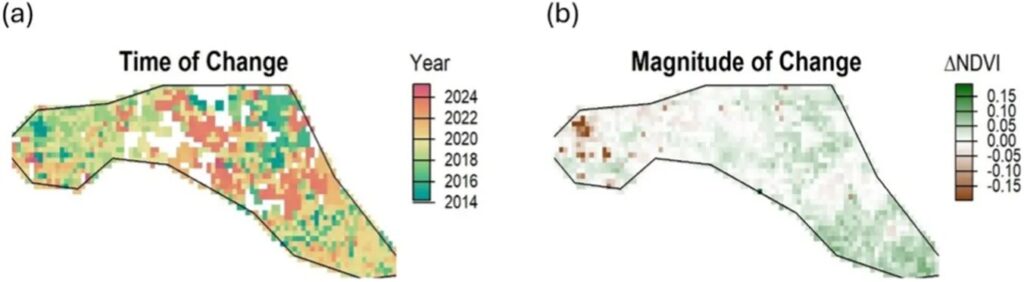
That finding matters for rhinos because black rhino habitat depends on plant structure. Vegetation change is not just a background environmental issue; it can alter browse availability, cover, resting habitat and movement patterns.
Dry-season conditions and black rhino sightings
Dry-season conditions can improve black rhino visibility because grass is often lower and water-linked habitat becomes more important. The dry season can also increase habitat pressure where browse becomes limited or where many animals concentrate around remaining green patches.
A dry-season black rhino search should focus on:
- cover near water;
- riverine vegetation;
- dam-influenced browse;
- thicket edges;
- fresh tracks in dust;
- dung middens near movement routes;
- browsed woody stems;
- shaded resting places during warm hours.
The dry season can create better sight lines, but it does not make black rhinos behave like open-plains animals. A black rhino may still spend long periods in cover because cover provides shade, security and browse.
A good Kifaru Ark guide uses the dry season to read resource concentration. Lower grass helps the eyes, but water, browse and cover explain the animal.
Wet-season vegetation and black rhino sightings
Wet-season vegetation can reduce black rhino visibility because grass grows, shrubs flush, and animals disperse into more feeding patches. The wet season may make the habitat better for feeding while making sightings harder from a vehicle.
Wet-season black rhino viewing requires patience because:
- fresh browse occurs across more areas;
- thick grass reduces sight lines;
- rhinos may use smaller habitat patches away from main roads;
- rain can soften tracks but also erase older signs;
- lush vegetation can hide cow-calf pairs;
- thicket and riverine growth can conceal movement.
The wet season often produces a richer ecological landscape, not necessarily an easier safari. Kifaru Ark should describe this honestly: the park may be better for rhinos at the same time that it becomes harder for visitors to see them.
Why black rhinos are harder to see than white rhinos
Black rhinos are harder to see because they use cover, browse and broken vegetation, while white rhinos are grazers that often feed in open grassland. The difference is anatomical, behavioural and ecological.
A white rhino lowers its square mouth to graze. A black rhino raises its head into shrubs and thickets. The white rhino’s feeding style exposes it in open areas. The black rhino’s feeding style puts it among bushes, drainage lines and woodland edges.
The safari effect is clear:
| Viewing factor | Black rhino | White rhino |
|---|---|---|
| Feeding style | Browses shrubs and woody plants | Grazes grass |
| Typical visibility | Often partly hidden | Often more exposed |
| Habitat clue | Thickets, shrub edges, riverine cover | Open grassland |
| Sighting duration | Often shorter or more interrupted | Often longer in open areas |
| Guide skill needed | Higher, especially for signs and habitat reading | Lower when animals are grazing in open view |
A black rhino sighting in Nairobi National Park may be brief, obscured or distant. That does not make it poor. It makes it ecologically honest.
Rhino sanctuary habitat pressure in Nairobi National Park
Rhino sanctuary habitat pressure increases when a compact protected area holds many large browsers, faces urban-edge fragmentation, loses safe dispersal space, or experiences vegetation stress. Nairobi National Park has to manage black rhino habitat inside a landscape where human infrastructure and land-use change press against the park boundary.
The Frontiers vegetation study describes Nairobi National Park as a rare urban wildlife sanctuary bordering Kenya’s capital and notes that urban expansion, infrastructure development and shifting land tenure are accelerating habitat disturbance. The same study links historical wildlife movement through the park’s unfenced southern boundary to the broader Athi-Kapiti ecosystem, then notes that the Standard Gauge Railway, Southern Bypass and expanding settlement have contributed to progressive habitat fragmentation.
For black rhinos, habitat pressure is not only about losing land. It is about losing options:
- fewer safe places to disperse;
- higher density inside secure areas;
- stronger competition for browse;
- more territorial pressure;
- higher need for translocation;
- greater dependence on ranger monitoring;
- more careful management of visitor disturbance.
A successful rhino sanctuary can become crowded. Crowding can increase sighting chances, but it can also reduce habitat comfort for the animals.
Fenced northern, eastern and western boundaries
The fenced northern, eastern and western sides of Nairobi National Park help protect rhinos from direct urban contact, but they also compress ecological movement into a smaller managed system. The management plan states that the park is fenced along three sides adjacent to urban housing, industries, roads, airports and Ngong Road Forest, with the southern border along the Mbagathi River partly open for animal dispersal.
Fencing creates a conservation trade-off:
| Conservation benefit | Ecological cost |
|---|---|
| Reduces uncontrolled rhino movement into urban areas. | Limits natural dispersal and range expansion. |
| Improves patrol efficiency. | Concentrates animals inside the sanctuary. |
| Protects rhinos from roads and settlement. | Increases dependence on carrying-capacity management. |
| Makes monitoring easier. | Reduces ecological freedom during drought or density pressure. |
This is why fenced sanctuary management must include population monitoring, habitat monitoring and translocation planning. Fences protect rhinos, but fences do not remove the ecological need for space.
Open southern boundary history and black rhino conservation
The open southern boundary history matters because Nairobi National Park was ecologically connected to the Athi-Kapiti and Kitengela plains. The park’s management plan states that Nairobi National Park is intimately linked to the Kitengela and Athi-Kapiti plains to the south, forming a single ecological unit.
Black rhinos are not migratory wildebeest, but they still need the broader principle behind that connection: large mammals require space, habitat variation and safe movement options. A black rhino sanctuary becomes more dependent on active management when surrounding land use reduces ecological flexibility.
For Kifaru Ark, the southern boundary should be interpreted as a conservation lesson. Nairobi National Park’s rhino protection works because the park is secure, monitored and actively managed. The same protection becomes more demanding as surrounding dispersal landscapes fragment.
Habitat fragmentation and rhino security
Habitat fragmentation affects rhino security because it reduces safe movement and increases the number of edges where wildlife, people, roads and infrastructure meet. Nairobi National Park’s urban-edge position makes black rhino protection visible and difficult at the same time.
The Frontiers study states that roads, railways and fencing have disrupted natural dispersal zones, creating threats to wildlife movement and vegetation integrity. It recommends prioritizing ecological connectivity, compatible land use in buffer zones and alignment with Nairobi’s urban development planning.
For black rhinos, fragmentation creates 4 linked risks:
- Spatial compression — rhinos have fewer safe areas to use.
- Density pressure — more animals may compete within the secure sanctuary.
- Security exposure — animals that move beyond secure zones become harder to protect.
- Habitat simplification — loss of connected habitat reduces ecological resilience.
This is where Nairobi National Park becomes ecologically unusual. The same city that makes the park accessible also surrounds the rhino sanctuary with pressure.
Rhino habitat carrying capacity
Rhino habitat carrying capacity is the number of rhinos a habitat can support while maintaining good body condition, calf survival, breeding performance, browse quality and social stability as detailed in this SADC Report. Carrying capacity is not the maximum number of animals that can physically fit inside the park.
The black rhino carrying-capacity model explains why managers worry about density. The model states that managing black rhino numbers relative to carrying capacity, around 75% of ecological carrying capacity, can promote productivity and prevent density-dependent declines in breeding performance and increases in mortality.
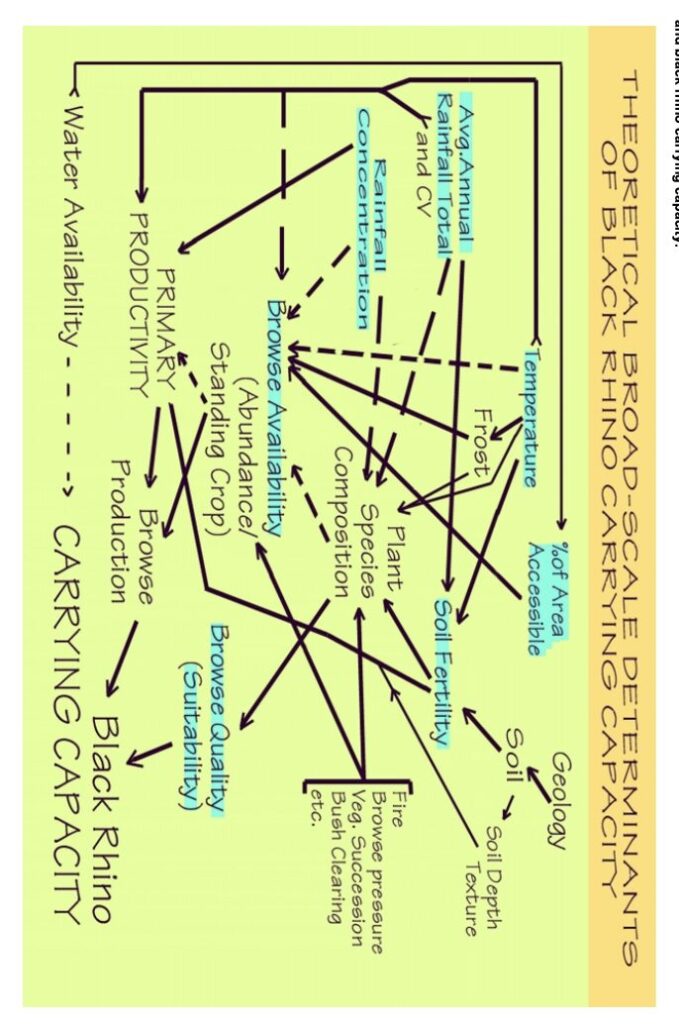
For Nairobi National Park, carrying capacity depends on:
- browse quantity;
- browse quality;
- vegetation height and structure;
- availability of dry-season feeding patches;
- water distribution;
- thicket and riverine cover;
- competition with other browsers;
- rhino density;
- disturbance levels;
- safe movement space;
- security and patrol coverage.
A park can hold many rhinos and still require removals or translocations. That does not mean the sanctuary has failed. It means the population has grown beyond the habitat’s most productive management level.
Rhino density in a small protected area
Rhino density in Nairobi National Park matters because a small protected area can become both excellent for sightings and ecologically tight for rhinos. Higher density may increase the chance that you see rhinos during a game drive, but it can also intensify browsing pressure, territorial conflict and the need for translocation.
High density creates different meanings for different audiences:
| For visitors | For rhino managers |
|---|---|
| More rhinos may improve sighting chances. | More rhinos may increase habitat pressure. |
| Rhino presence feels more reliable. | Breeding performance must be monitored. |
| Game drives may feel more rewarding. | Territorial conflict and calf survival matter. |
| Conservation success is visible. | Carrying capacity and genetics require active management. |
Kifaru Ark should explain this clearly. A rhino sanctuary should not aim to hold the largest possible number of rhinos forever. It should aim to hold a secure, productive and genetically viable population while supporting Kenya’s wider rhino metapopulation.
Why Nairobi National Park is ecologically unusual for rhinos
Nairobi National Park is ecologically unusual for rhinos because it combines a black rhino sanctuary, diverse habitat mosaic, high visitor accessibility, urban-edge pressure, fenced boundaries and historic dispersal connections inside only about 117 square kilometres. The park is Kenya’s first national park, sits close to Nairobi city centre, and remains one of the few protected areas globally located beside a capital city.
The unusual ecology comes from the combination, not from one feature:
| Feature | Why it matters for black rhinos |
|---|---|
| Urban-edge location | Rhino protection must operate beside city pressure. |
| Habitat mosaic | Shrubland, woodland, grassland, rivers and dams create varied rhino habitat. |
| Compact size | Density and carrying capacity become central management concerns. |
| Fenced boundaries | Security improves, but natural movement becomes constrained. |
| Partly open southern history | The park retains ecological links to wider Athi-Kapiti logic. |
| High visitor use | Safari quality must be balanced with rhino welfare. |
| Vegetation stress | Browse, cover and movement patterns may shift over time. |
| Active sanctuary management | Rhinos survive through protection, monitoring and ecological decision-making. |
Nairobi National Park is not a remote rhino wilderness. It is a compact, pressured and scientifically managed rhino sanctuary where habitat, security and visitor behaviour meet every day.
How black rhino habitat affects safari quality
Black rhino habitat directly affects safari quality because the best rhino habitat is often not the easiest viewing habitat. Thickets, shrubland, forest edges and riverine cover support black rhinos, but they also hide them.
A realistic Kifaru Ark safari should explain this before the game drive:
| Habitat condition | Safari effect |
|---|---|
| Open grassland | Better visibility, but often stronger for white rhinos and plains game. |
| Shrubland and thickets | Better black rhino logic, but harder viewing. |
| Riverine cover | Strong signs and movement corridors, but often partial visibility. |
| Dry season | Lower grass can help viewing, but rhinos may use shade more strongly. |
| Wet season | Better browse can spread rhinos out and reduce predictability. |
| High visitor pressure | Guides should avoid crowding and protect calm animal behaviour. |
| Skilled guiding | Better interpretation of signs, cover, browse and movement patterns. |
The best black rhino safari is not always the closest rhino sighting. The best sighting is one where the animal remains calm, the guide understands the habitat, and you leave knowing why the rhino was there.
How a Kifaru Ark guide reads black rhino habitat
A Kifaru Ark guide should read Nairobi National Park as a layered rhino habitat system, not as a list of animal locations. The guide should interpret vegetation, water, soil, cover, signs and disturbance together.
A strong black rhino guide asks:
- Where is the browse?
Black rhinos need shrubs, woody shoots and reachable vegetation. - Where is the cover?
Thickets, forest edges and riverine vegetation let rhinos rest and avoid disturbance. - Where is the water?
Dams, rivers and wetland edges influence dry-season movement. - Where are the signs?
Tracks, dung middens, browsed twigs and repeated paths often reveal rhino activity. - What has the season changed?
Rain, grass height and fresh browse alter visibility and movement. - What pressure is present?
Vehicles, boundaries, fences, settlement edges and high-density wildlife use change behaviour. - Is the rhino calm?
A relaxed rhino is feeding, walking or resting naturally. A stressed rhino is warning the vehicle to leave.
This is the difference between ordinary game driving and rhino interpretation.
What visitors should understand before looking for black rhinos
Nairobi National Park gives you a real chance to understand black rhinos, but the park does not always give you an easy photograph. Black rhinos use the parts of the landscape that protect them: thickets, shrub edges, riverine cover, forest margins and broken ground. Those places are good for rhinos because they provide food and security, not because they provide perfect visibility.
You should judge a rhino safari by 4 standards:
- Habitat interpretation — Did the guide explain why the rhino was using that area?
- Animal welfare — Did the vehicle keep enough distance for the rhino to remain calm?
- Ecological understanding — Did you learn how browse, cover, water and season shape sightings?
- Conservation context — Did the guide connect the sighting to sanctuary protection and habitat pressure?
A black rhino sighting becomes more meaningful when you stop asking only, “Did we see one?” and start asking, “Why is this animal able to live here?”
Kifaru Ark perspective: the real habitat story
Nairobi National Park’s black rhino habitat story is not about one secret rhino area. The real story is a compressed habitat mosaic where black rhinos use browse-rich shrubland, thickets, dwarf-tree grassland, forest edges, riverine cover, dams, drainage lines and movement edges inside a protected area surrounded by urban pressure.
That is what makes Kifaru Ark different from ordinary safari branding. Nairobi National Park protects black rhinos by holding together habitat, security and science in a landscape where all three are under pressure. The park’s cover makes black rhinos harder to see. Its browse makes them able to feed. Its water and drainage lines shape movement. Its fences improve protection but increase carrying-capacity pressure. Its southern ecological history reminds us that large mammals need more than administrative boundaries.
A black rhino in Nairobi National Park is therefore not just a large grey animal in a city park. It is a browser living inside a managed urban sanctuary, responding to vegetation height, thicket structure, riverine cover, water access, density, disturbance and fragmentation. Kifaru Ark should help visitors see that full picture. The rhino sighting matters, but the habitat explains why the rhino is still there.